

- PRODUCT
- CROSS-PLATFORM
- ROLE
- SENIOR UX DESIGNER
- TIMELINE
- MULTI-YEAR EXPLORATION
- SKILLS
- RESEARCH, DESIGN & PROTOTYPING
/AT A GLANCE
PROBLEM
Linear, module-specific workflow tools could not clearly represent branching, loops or parallel work. Configuration was fragmented and live progress was difficult to monitor.
OWNERSHIP
I led the UX work across research, requirements, the interaction model and prototypes, partnering with product, engineering and customer super users across several industries.
OUTCOME
The work established a reusable visual workflow model and reached customer trials. The direction was validated, but wider organisational change paused the initiative before production.
/OWNERSHIP
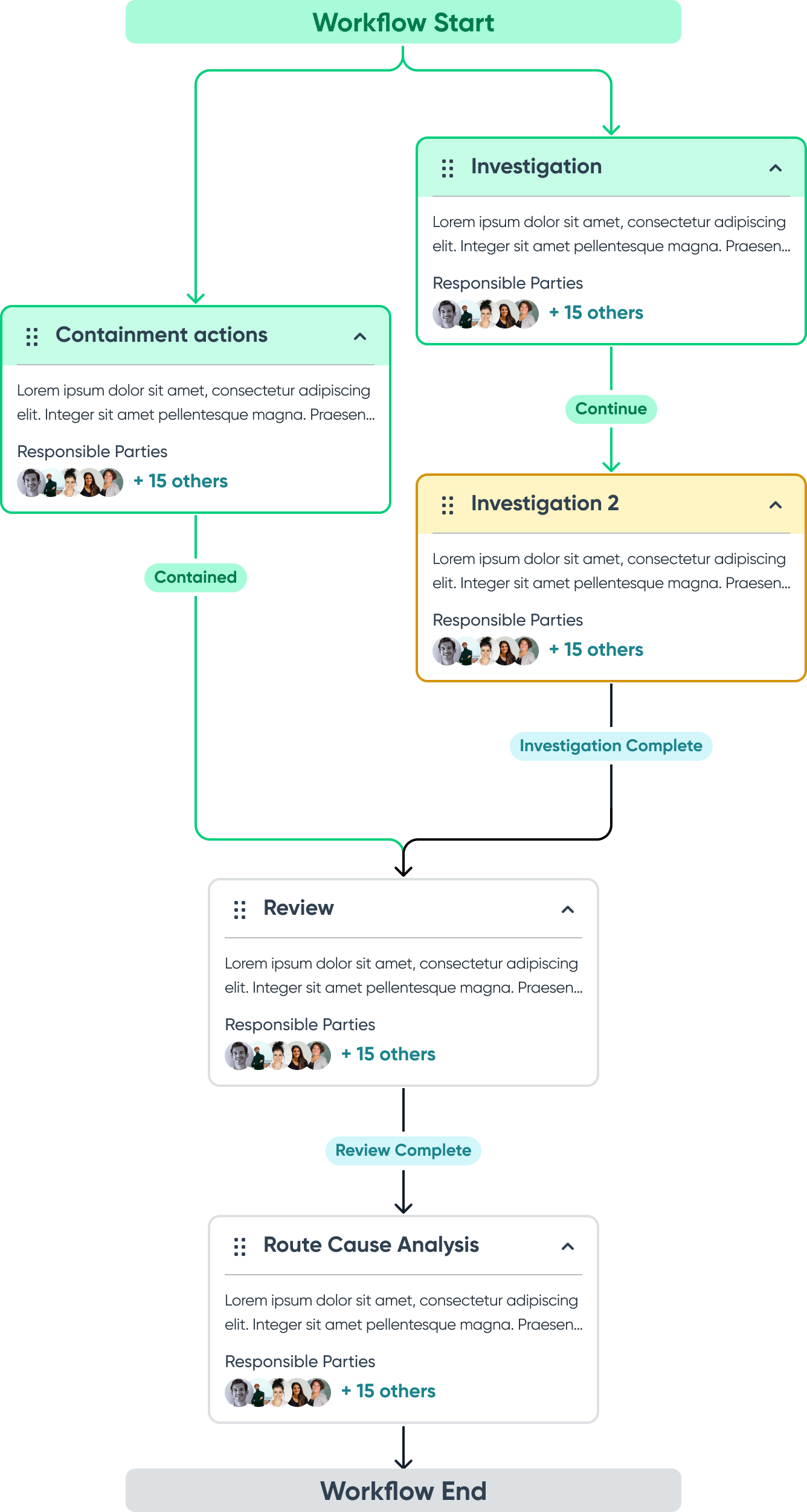
I led the UX work across the project’s different phases, drawing on my earlier experience mapping customer processes as an Implementation Manager. I owned the research synthesis, requirements, interaction model and prototypes for the visual builder, configuration and reporting experience, while working with product, engineering and customer ‘super users’ to balance technical constraints, migration needs and regulated working practices.
/INTRODUCTION
My perspective on this problem came from both sides of the product. As a Quality Assurance Manager, I mapped manufacturing processes and maintained the controls around them. Later, as an Implementation Manager, I helped organisations including BT, Sodexo, Diageo, Honeywell, the NHS and Accolade Wines translate their procedures into quality management software.
As I moved into product design, that domain knowledge shaped a broader question: how could one visual workflow model support everything from document approval to complaints, safety incidents and corrective actions across a growing product suite?
The exploration continued through organisational and product changes, moving from research to prototypes and customer trials. I think I see workflows in my sleep at this point.
/THE USERS
PROCESS OWNERS
Managers and administrators need to model, govern and improve processes while maintaining visibility of ownership, deadlines and compliance.
PARTICIPANTS
Employees and temporary workers need to understand what is required, complete the right task and trust that they are following the approved procedure.
The experience therefore had to support complex web-based configuration without making day-to-day participation feel complex on desktop, tablet or mobile.
/THE CHALLENGE
Processes vary dramatically between organisations and industries. The model needed to handle branching, loops, decisions, permissions, migration and reporting without losing clarity.
/THE INTERACTIVE CANVAS
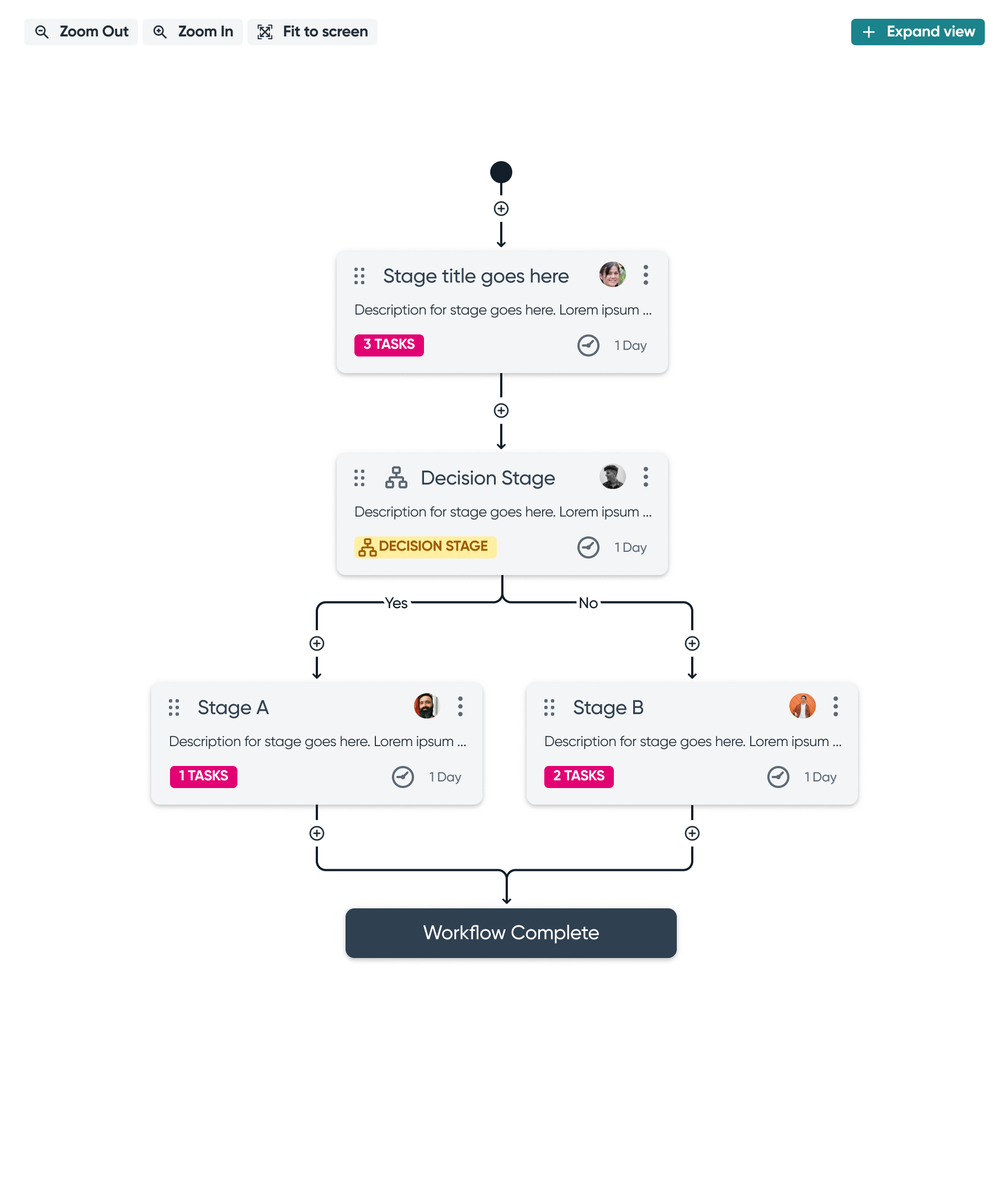
The core design decision was to replace module-specific action lists with a shared visual model. Stages grouped related actions, decision stages created explicit branches, and connectors showed sequence, parallel work and loops. Inline configuration kept administrators on the canvas, while consistent status states connected configuration to the way live work would later be tracked.
DESIGNING FOR BOTH SIDES
The canvas needed to work for administrators configuring complex rules and for employees completing the resulting tasks. Progressive detail kept the overall route legible while side panels held configuration, ownership and supporting information.
We treated complex examples as the test, not the exception: dozens of decisions, parallel lanes, loops and permissions that protected live work while still allowing subject-matter experts to improve a process.
/RESEARCH
Research combined existing customer evidence with direct evaluation and feedback from experienced users across several industries.
EXISTING EVIDENCE
Customer configurations and process-mapping work showed the range of workflows the model needed to support.
HEURISTIC REVIEW
We evaluated the current experience to identify configuration friction, inconsistencies and accessibility gaps.
USER RESEARCH
Workshops and in-product questionnaires captured how super users configured, monitored and reported on real processes.
WHAT WE FOUND
Users could often achieve the required end result, but configuration and daily management were difficult to relearn and inefficient to operate. Complex setups also made progress and outcomes hard to report accurately.
/VALIDATION
Validation ran throughout the project rather than waiting for a final design.
REAL PROCESSES
Existing customer configurations and workshops with super users gave us representative processes to map, from straightforward approvals to branching, looping and parallel work.
ITERATIVE PROTOTYPES
We moved from early canvas wireframes to high-fidelity prototypes and sandbox builds, using each round of feedback to refine how users created, connected and understood stages.
EDGE CASES
We stress-tested complex paths, permissions, migration and reporting so that the model worked beyond a clean demonstration and reflected the realities of live, regulated processes.
/REQUIREMENTS
The evidence resolved into four connected themes.
WORKFLOW MODELLING
Represent sequential, parallel and branching paths, decision points and loops without forcing teams to simplify the real process. Reusable sections and templates should make common approval and review patterns faster to configure.
GOVERNANCE AND VERSIONING
Control who can create, edit, review, publish or retire a workflow. New versions must be approved without disrupting work already in progress, while existing customer configurations need a safe migration path and a reliable audit history.
TRACKING AND REPORTING
Show what is complete, active, overdue or blocked, who owns the next action and which route was taken. Filtering, escalation rules and drill-down reporting should support both operational management and audit evidence.
USABILITY AND VALIDATION
Keep large workflows understandable through clear grouping, labels, navigation and visual states. Before publication, identify missing connections, unreachable stages and loops without exits, then explain how to resolve them.
/CONFIRMED FEEDBACK
In hands-on demonstrations and customer trials, participants responded positively to the visual approach and could recognise the process maps they already used in tools such as Visio and on whiteboards.
Some users preferred the familiar linear interface, which reinforced the need for a considered transition and, where appropriate, an alternative view rather than forcing every user onto the canvas immediately.
/PROPOSED BENEFITS
If taken into production, the design was intended to reduce configuration effort through inline setup, make complex paths easier to understand, and give managers earlier visibility of ownership, delays and bottlenecks. These remained expected benefits rather than measured outcomes because the wider initiative was paused before launch.
/OUTCOME
The project established and tested a reusable interaction model for workflow design across the product suite. It progressed from research and wireframes to high-fidelity prototypes and customer trials, but acquisitions, portfolio changes and organisational restructuring shifted investment before a production release. The work remains a validated strategic direction rather than a shipped feature with post-launch metrics.
/NEXT STEPS
I would take the validated model forward as a shared workflow platform across the suite, then explore carefully governed AI assistance: translating approved procedures into draft workflows, identifying bottlenecks and suggesting improvements while keeping review and publication decisions with the people who own the process.